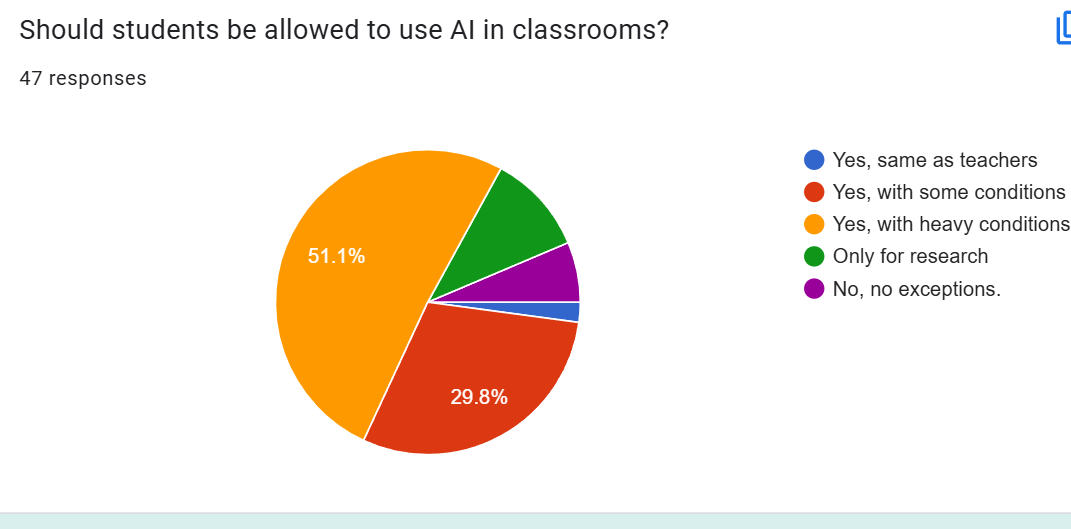



Artificial Intelligence tools are increasingly present in classrooms at MIHS, prompting questions about academic integrity, teacher use and how students should be prepared for a future where AI skills may be expected. Interviews with teachers and students, along with a recent staff survey conducted by The Islander, show that while AI is widely used by educators, expectations for student use remain inconsistent.
In a survey of 47 MIHS teachers and staff, most respondents reported using AI at least occasionally. 38.3% said they use AI occasionally, while 19.1% reported using it daily and another 19.1% weekly. 23.4% said they never use AI.Teachers most commonly reported using AI for creating assignments or instructional materials (53.2%) and lesson planning (34%). Smaller percentages said they use AI to check for plagiarism (19.1%), create exams (14.9%), or grade students’ work (4.3%). Responses varied widely when teachers were asked whether AI makes their work more efficient, suggesting differing experiences and comfort levels with technology.
English teacher Carrie Thompson said AI itself is not the issue, but how it is used.
“I think we’re doing students a disservice if we’re not giving students avenues to understand how to use it,” Thompson said, adding that AI skills are already expected in some workplaces. However, she warned that when students rely on AI to think for them, it undermines foundational skills like writing and critical analysis.
Social studies teacher Jamie Robertson described AI as “a good tool for teachers,” but said it is often inappropriate for students when it replaces their thinking. He referenced “cognitive offloading,” saying that learning requires students to struggle with ideas rather than outsource the process.
Two MIHS juniors interviewed said AI use among students is common, especially for writing assignments. Junior Nate Rodman said AI use is “definitely widespread,” particularly for essays, and believes MIHS’s strict policy is reasonable when AI use becomes plagiarism.
“It’s counterfeit words and counterfeit ideas,” Rodman said. Junior Jonah Lynch said he primarily uses AI for grammar and revision. He said teacher use of AI can be fair if it improves instruction, but raised concerns after a test he believed included AI-generated material that covered content not discussed in class.
According to Mercer Island School District’s AI guidance, AI tools can “support student learning, enhance instruction and streamline tasks for staff when used responsibly.” Rather than outlining strict classroom rules, the policy emphasizes values such as transparency, privacy, safety and academic integrity, and notes that AI tools must comply with federal privacy laws like FERPA.
Several interviewees suggested that education should accompany restrictions. Thompson and both students supported the idea of teaching students how to use AI ethically and responsibly, potentially through a dedicated course, while Robertson said he remains open-minded but unsure what such a class would look like.
As AI becomes more embedded in daily life, MIHS continues to navigate how to balance academic integrity, meaningful learning and preparation for a workforce increasingly shaped by AI.