

Navigating the high-stakes world of technology and finance often feels like a closed-door conversation held in glass boardrooms, far removed from the daily life of a high school student.
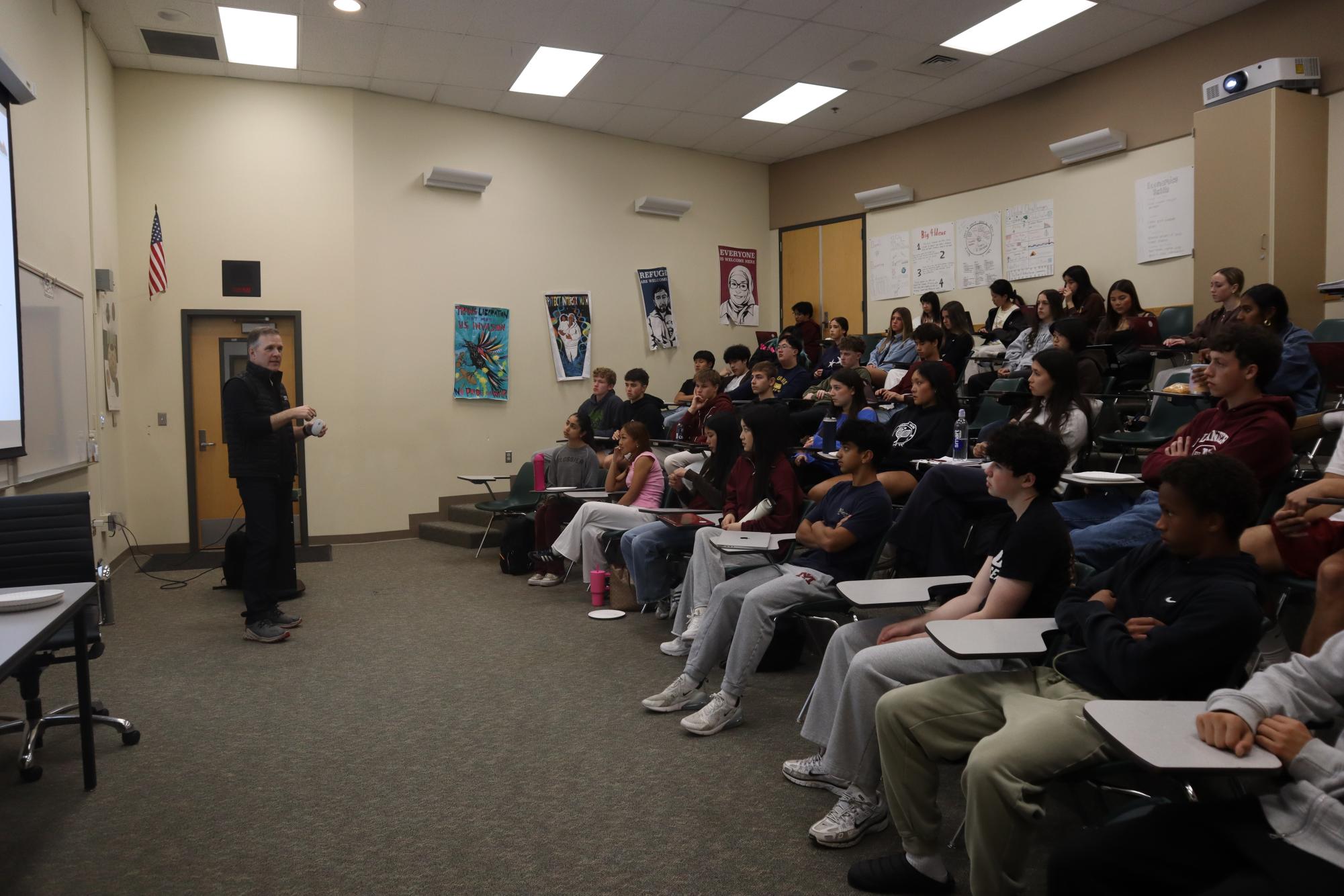
Fortunately, on April 24, the doors of the Little Presentation Room (LPR) opened to a masterclass in entrepreneurship as BJ Lackland, a managing partner at Equal Capital and a seasoned tech executive, shared his journey from a curious student to a pioneer in alternative growth capital.
With over 25 years of experience funding and operating technology companies, Lackland has sat on both sides of the table as both a CEO and a venture investor. Having funded over 300 companies and invested approximately $350 million throughout his career, he visited Mercer Island High School to demystify the financial industry and provide a roadmap for the next generation of business leaders.
For most students, the term “Venture Capitalist” is synonymous with “Shark Tank,” but Lackland described the role in far more practical terms: middleman.
“Actually, as an investment manager or as a venture capitalist and all that, you’re just kind of a middleman,” Lackland explains during the talk. “All we do at Equal Capital is we take money from investors who want to make money… and then we figure out how to give it to startup companies and give the best returns from it.”
Although the concept is simple, taking money from one side and placing it out on the other, the execution is where the difficulty lies. Lackland highlighted the traditional “262 rule” of venture capital: out of every ten investments, two are “home runs” (making 10x or 100x returns), two are “complete duds” where all money is lost and six are expected to break even.
Despite his background as a traditional VC, he is best known for pioneering a different model: Revenue-Based Financing (RBF). Unlike traditional venture capital, which requires founders to give up ownership (equity) in their business, Lackland’s current firm, Equal Capital, focuses on stable companies that do not want a co-owner.
“Venture capitalists find a promising startup, provide significant capital, and receive an equity stake in return,” Lackland says. “We are different. We focus on stable companies and entrepreneurs who want to avoid co-ownership… we are the masters of the single.”
By providing what he calls “quasi-debt”—a loan with equity upside—Lackland helps established companies. These businesses, typically generating between $4 million and $40 million in revenue, scale without the founder losing control of their vision.
A key takeaway for the students gathered in the LPR was Lackland’s candid admission that his professional journey followed a winding, non-linear path.
“I didn’t know what I was going to do until I was at least 35 years old,” Lackland told the room. “In high school, until midway through my senior year, I thought I wanted to be like a scientist. I was super into STEM topics.”
His journey took him across the globe, from living in a mud hut in Nepal to teaching high school in Taiwan for three years. He later returned to the University of Washington to earn an MBA and a master’s in Chinese political economy, originally intending to become a professor. It wasn’t until he joined a startup and realized the CEO didn’t want to raise capital that he stepped into the position of fundraiser, beginning the trajectory he is on today.
In an interview following the presentation, Lackland shared his motivation for returning to a high school setting and his outlook on the future of work.
“What excites me the most about the future of tech and entrepreneurship is that I think it’s actually in some ways getting easier to be an entrepreneur than it used to be,” Lackland said.
Lackland clarified that while the work remains difficult, the accessibility of sophisticated software and global networks has lowered the traditional barriers to entry. He pointed to the rise of SaaS and AI as tools that now allow small teams to execute complex operations that once required massive corporate infrastructure.
He emphasized that being “entrepreneurial” is a mindset that all students should adopt, regardless of whether they start a business. “Being entrepreneurial is thinking through what other people need and then serving that need.”
For students looking to break into finance or capital management, Lackland stressed the importance of being an informed observer of the world.“The most important thing is just learning as much as you can… like reading the newspaper… researching [businesses] and trying to figure out how your chosen area works,” Lackland advised. “It’ll tell you if that is really an area you’re interested in, and it’ll help you understand the world out there.”
Additionally, he warned against the two most common pitfalls for young founders: thinking the process is easy and fearing failure. Lackland noted that these often occur in tandem; the initial assumption that success is easily attained can lead to a paralyzing fear of failure at the first sign of a real obstacle. Rather than sliding toward one extreme, many entrepreneurs struggle to balance the optimism required to start with the resilience needed to survive inevitable setbacks.
As Lackland concluded his talk, his message was clear: whether pursuing a degree in Entrepreneurship, Business, Computer Science or launching a niche startup, success in the “fast-paced world” of business requires curiosity, people skills and the willingness to take a winding path to find your place in the market.